At Schneider Electric, we believe inclusion is a practice. It’s built in the everyday moments employees feel heard, supported, and empowered to lead the way.
Each year on December 3, the world recognizes the International Day of Persons with Disabilities (IDPD)—a United Nations observance dedicated to promoting the rights, well-being, and full participation of people with disabilities in all areas of society. It’s a moment to reflect on progress, confront remaining barriers, and reaffirm our shared responsibility to build more accessible, equitable communities.
This year, Schneider is highlighting the well-known disability rights movement sentiment, “Nothing about us, without us.” While not the official UN theme for IDPD, the phrase captures a central truth that guides our work: decisions that impact people with disabilities must include their voices and lived experiences.
This commitment is not new for Schneider Electric. Disability inclusion is woven into our journey—shaped by employee voices, strengthened by global initiatives and inclusive policies, and rooted in a culture of respect, accessibility, and care.
Why disability inclusion matters—globally and at work
Across the world, disability is far more common—and far more diverse—than many people realize.*
- Nearly 1 in 4 U.S. adults and 1 in 5 Canadians live with a disability.
- More than 70% of disabilities are non-visible, ranging from neurodiversity to chronic illness.
- 80% of disabilities are acquired during working years, meaning accessibility impacts nearly every career journey.
- And yet, fewer than 4% of employees disclose a disability at work, often due to stigma or fear of bias.
These realities underscore why accessibility must be a foundational part of how we work, design, and lead.
Listening first. Then acting together.
Many disability-related barriers remain invisible until someone names them. Employees across Schneider have helped reveal those barriers and inspire change—from digital design adjustments to improvements in physical spaces.
One example began with a simple question from an employee: “How can we make it easier for everyone to navigate our sites independently?”
This question led to the Accessible Navigation & Wayfinding pilot, introduced at our Boston Hub. The pilot included digital beacons and audio navigation designed to assist people with visual or mobility impairments. What started as a localized initiative opened broader conversations about accessibility across Schneider—and continues to inform how we design inclusive workplaces. Read more in the blog.
This is the heart of our approach: listen, learn, then act—together.
Building community through DAA Employee Resource Networks
Employee voice is central to disability inclusion at Schneider. Our Disability, Accessibility & Allies (DAA) Employee Resource Networks bring that voice to the forefront.
DAA ERNs now exist in the United States, Canada, France, Mexico & Central America—and have recently expanded to India and China. They support employees with disabilities, caregivers, and allies, while also helping shape programs, influence accessibility standards, and elevate lived experiences.
In a 2024 reflection, Cody White, Senior Process Specialist, shared how joining the ERN expanded his understanding of accessibility:
“I quickly realized I had no idea about accessibility. I learned that tools I rely on every day were created for someone with a disability—and that much of the content I create isn’t accessible by default. This awareness allowed me to tailor my work to reach more people.”
Cody’s experience reflects what the DAA ERN brings to Schneider: deeper awareness, stronger allyship, and meaningful, employee-led change.
Experiences that shift perspective: Office Olympics Accessibility Initiative
Another powerful example of awareness in action is the Office Olympics Accessibility Initiative, hosted in 2024 and 2025 by the Emerging Professionals Network in partnership with the DAA ERN. Designed to build connection and empathy, the event invited employees to step into the shoes of colleagues who encounter accessibility barriers every day.
Through hands-on challenges such as navigating in wheelchairs, participating in blindfolded obstacle courses, completing fine-motor tasks with restricted dexterity, and exploring sensory sensitivities, employees experienced firsthand how design barriers affect daily life.
Initiatives like this remind us that when people understand the lived experiences of others, inclusion shifts from policy to practice.
Embedding accessibility in digital tools and workspaces
Our commitment goes beyond observance days. Accessibility is becoming embedded into the foundation of how we work, design, and communicate.
Key areas of progress include:
- Global digital accessibility standards
- Accessibility learning for all employees
- An “Accessibility by Design” course for R&D teams
- Accessible communication templates and content tools
- Physical workplace improvements across hubs and plants
- Partnerships with The Valuable 500 and Business Disability Forum
These efforts reflect our long-term ambition: workplaces, technologies, and employee experiences that are inclusive by default.
Recognizing progress: 2025 Disability Equality Index
In 2025, Schneider Electric U.S. and Canada each achieved a top score on the Disability Equality Index (DEI)—the world’s leading benchmark for measuring disability inclusion in business. Awarded by Disability:IN, this recognition designates Schneider Electric as a “Best Place to Work for Disability Inclusion” and reflects our ongoing efforts to build accessible, equitable workplaces.
Our performance on the index has strengthened steadily over time. In the United States, our score increased from 80 in 2022, to 90 in 2023, and to a top score of 100 in both 2024 and 2025. This upward trajectory demonstrates the impact of accessibility initiatives, employee advocacy, and cross-functional collaboration happening across the region.
We’re also proud to celebrate Canada’s first year participating in the DEI, earning a top score of 90. This result highlights the growing momentum behind disability inclusion efforts across Canada and North America more broadly.
While we celebrate this recognition, we also recognize that disability inclusion is a continuous journey. It is both a responsibility and a business imperative—one that strengthens innovation, enhances performance, and helps ensure all employees can contribute fully and thrive.

Voices driving change
Our progress continues to be shaped by employees who share their experiences—through ERNs, awareness events, or storytelling campaigns. Their insights remind us that inclusion isn’t a one-time achievement; it’s an ongoing commitment.
Across these reflections, one message is consistent: inclusion begins by acknowledging that people have different needs—and designing with those differences in mind enables everyone to do their best work.
Why this matters for candidates considering Schneider Electric
We share these stories not because they’re perfect, but because they’re real. And because when people choose an employer, they’re choosing more than a job—they’re choosing a culture.
Candidates joining Schneider Electric can expect:
- A workplace rooted in belonging and care
- Leaders committed to curiosity and inclusion
- Communities like DAA ERNs where employee voices drive action
- Growing global accessibility programs
- Flexibility in how teams work
- A culture where every story matters
Honoring IDPD 2025 and building what comes next
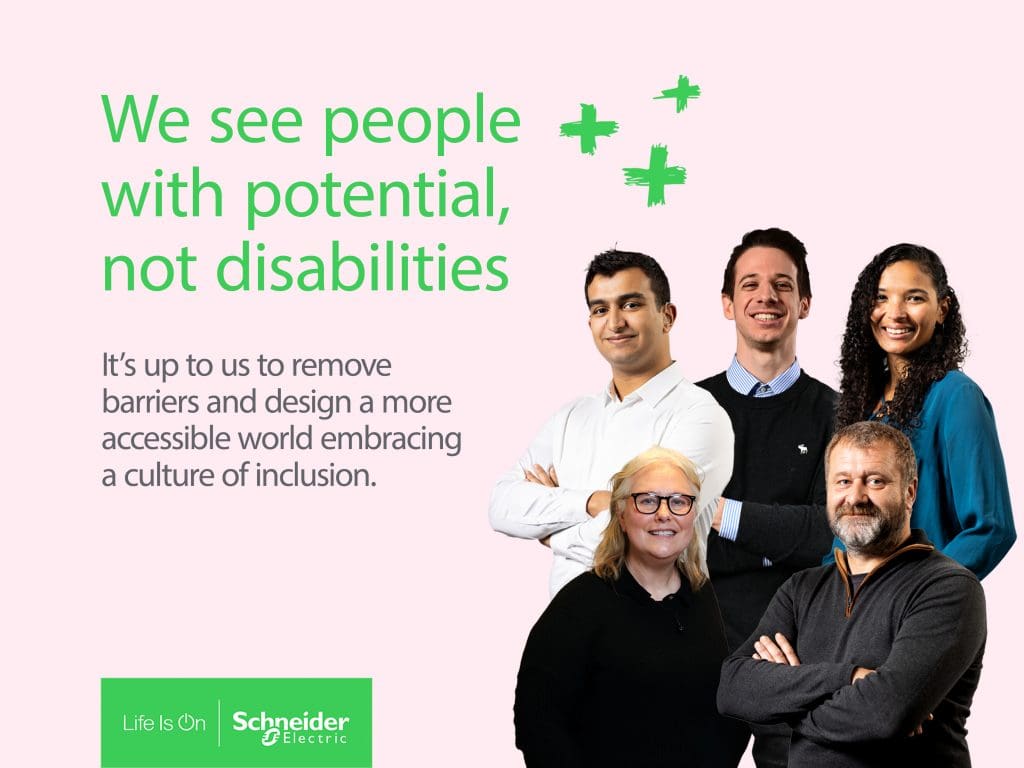
This International Day of Persons with Disabilities, we honor the employees who shape our culture—through their leadership, advocacy, and lived experience.
Because when we say “Nothing about us, without us,” we mean it.
And we know our progress depends on the people who courageously help us grow.
Call to Action
If you want to build a career where your voice matters—and where inclusion is something we act on, join our talent community and explore career opportunities at Schneider Electric.
*Sources include the U.S. Centers for Disease Control and Prevention (CDC), Statistics Canada, the Job Accommodation Network (JAN), The Valuable 500, and Accenture’s “Disability Inclusion Advantage” research.



Add a comment