There exists a quiet confidence to Copenhagen. When I last went, the streets and waterways sparkled, the bikes outnumbered the cars, and the air felt filtered by surrounding nature. It doesn’t claim to be utopia. It’s just a place that behaves as if the future already happened.
This October, our Innovation Summit will once again gather customers, partners, external industry leaders, and policymakers to decide the future of energy and resilience. These aren’t abstract themes; they’re material challenges that Copenhagen has tackled for years. While other cities theorize about sustainability, Copenhagen builds it, rides it, and occasionally swims in it.
Setting the Pace
Denmark was recently named the most resilient country in the world — a reflection of its infrastructure, energy systems, and civic culture. The country claims the highest share of renewable energy integration in Europe: 88.4%. That’s no piece of Lagkage either; Denmark is outpacing even the most progressive grids, including Sweden and Portugal.
But energy generation is only half the story. The other half is management: storing the energy, moving it efficiently, and using it resourcefully. This is where many countries and economies begin to strain. Europe, in particular, is hamstrung by high energy costs and slow electrification. One of our panels this year will confront this issue: asking how businesses can treat energy as a strategic asset to be produced, optimized, and sold.
A model of urban innovation and energy transformation
Many of you have visited our Innovation Hubs around the world. If we could scale one up to the size of a city, it might look something like Copenhagen: low-carbon public transport, energy-efficient buildings, urban planning that prioritizes cycling, walking, and community life, and something that overall strives to make a positive impact on society. It’s proof of concept that sustainable living can and does exist.
And it didn’t happen by accident. Tourists may flock to the city’s charm, but beneath the surface lies a digital spine built by bold decisions and steadfast investment. Copenhagen uses AI to optimize traffic flow, recycles waste heat to power homes, and has banned new diesel cars from the city center. These are mature systems, embraced by industry and society alike.
Resilience is about people too
Copenhagen also ranks as one of the happiest cities in the world. This may have something to do with the fact that you can cycle from end to end, swim in the harbor without needing antibiotics, and send your children to kindergartens inside actual forests.
Happiness may seem like a soft metric, but it matters. When people feel secure and empowered, innovation begins to sizzle. That’s true in cities, and it’s true in companies. At Schneider Electric, our people consistently tell us they feel empowered, supported, and proud to build a sustainable future. In our recent company-wide survey, 77% of our employees said they feel aligned with Schneider Electric’s purpose. Like Copenhagen, we believe that sustainability is a core design principle.
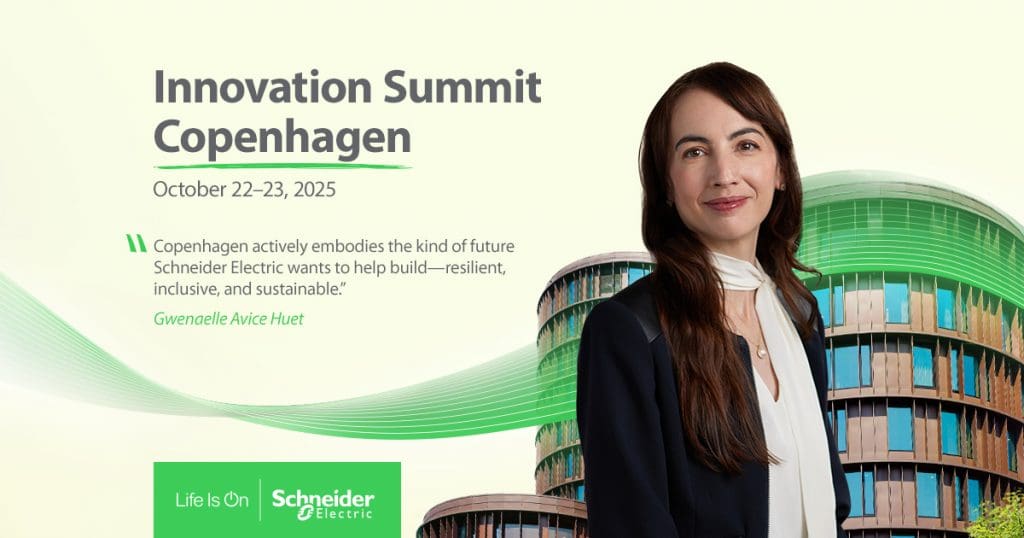
You may have seen recent examples of how a questionable location can throw shadows over an entire event. But Copenhagen actively embodies the kind of future Schneider Electric wants to help build — resilient, inclusive, and sustainable. Hosting the summit here isn’t just convenient. It’s coherent.
And beyond this symbolism lies hard practicality. Attendees will find an international city that’s bikeable, walkable, and equipped with exceptional facilities.
Electrifying the future
As the world’s most sustainable company, our mission is to drive industrial decarbonization through intelligent technology and expert guidance.
Take innovations like our SF6-free AirSet. This replaces a greenhouse gas, both very popular and very potent, with something far less harmful: air. Or let’s zoom out over a broader trend: electrification. In buildings, the combination of electrification and digital control, what we call Electricity 4.0, can reduce emissions by up to 70%. This isn’t wishful thinking. It’s a realistic assessment drawn from systems already in operation.
But our work is cut out for us. As of 2024, only a third of the energy in European industry is electric. We already have the technology to push that figure to almost 50%. What’s missing now is the alignment.
Innovation alone rarely moves the needle; to incentivize broad adoption, we need context, expertise, policy, and coordination. For this, the summit will assemble our powerful ecosystem of partners, helping organizations move from data to decisions — from vision to execution.
A leading city for a leading company
Schneider Electric’s Innovation Summit will be world-class, featuring expert sessions and a showcase of our frontier technologies. Like every year, it’s a chance for the industry to dock ideas, forge partnerships, and review the path forward. With Copenhagen as host city, those conversations are surrounded — and hopefully inspired — by tangible progress.
Because ultimately, this conference is a physical expression of our commitment to make the most of energy and resources, lifting sustainability off the page and into three-dimensional reality.
To learn more about the event, please visit our Innovation Summit Copenhagen 2025 page.



Add a comment