As extreme weather events heighten the urgency for reliable energy sources and cost-effective solutions, an increasing number of homeowners are embracing distributed energy resources (DERs) like solar and wind power as viable alternatives to traditional utility services. Developers installed 60 gigawatts of new solar capacity between 2019 and 2023, doubling the total from all previous years. In addition, wind capacity was up 57% over the same period.
With this shift, it is crucial for electricians and contractors to deepen their understanding of these new energy sources. Familiarity with the 2023 National Electric Code (NEC) requirements for their installation is equally important, as these regulations ensure the safe integration of these sources into an electrical system.
Both NEC 705.12 and NEC 705.13 focus on connecting power production sources, such as photovoltaic (PV) solutions, energy storage, and generators, to the home’s electrical system. This ensures reliable and efficient power distribution.
What is Section 705.12?
Section 705 of the 2023 NEC focuses on the interconnection requirements for Electric Power Production Sources. These are systems that generate electrical power in parallel with a utility and are capable of delivering energy to the main utility grid.
This NEC section sets the rules for connecting power sources on the load side of the service so as not to overload the interconnection cables and electrical equipment, such as the main electrical panel.
Part of this is disconnecting energy sources to ensure that the system can be isolated safely. This protects equipment from damage and ensures the safety of those working with the equipment.
705.12 requirements
More specifically, 705.12(A) provides the requirements for load side connections of DERs to feeders, and 705.12(B) provides the requirements for connecting DERs to equipment with busbars, such as the main electrical panel for a home.
705.12(A)(1) through (A)(3) and 705.12(B)(1) – (B)(5) are prescriptive requirements for specific scenarios – three scenarios that apply to all feeder connections, and five separate requirements for different scenarios for connections to equipment with busbars.
Where circumstances permit, these may be used to satisfy the requirements of 705.12 and are generally straightforward to understand and apply.
However, the ease of application and simplicity of the calculations required to implement these come with a trade-off – the rules are conservative and may require a feeder or equipment with a larger ampacity than would otherwise be the case. This can often mean that existing equipment used for the connection of DERs must be replaced to comply.
How 705.13 supports the requirements of 705.12
705.12(B)(6) is concerned with connections to switchgear, switchboards, and panel boards under engineering supervision. This section states that connections to busbars in switchgear, switchboards, and panel boards may be designed by a qualified engineer. This must include calculations for potential fault currents and for the loads that the busbars will carry under all operating modes of the system.
Engineering supervision for the design is required since these calculations can be complex and include evaluations of the internal construction of the equipment. The advantage of this method is that it allows the minimum equipment size that is technically feasible.
For an existing installation, this can mean the difference between having to replace equipment or not.
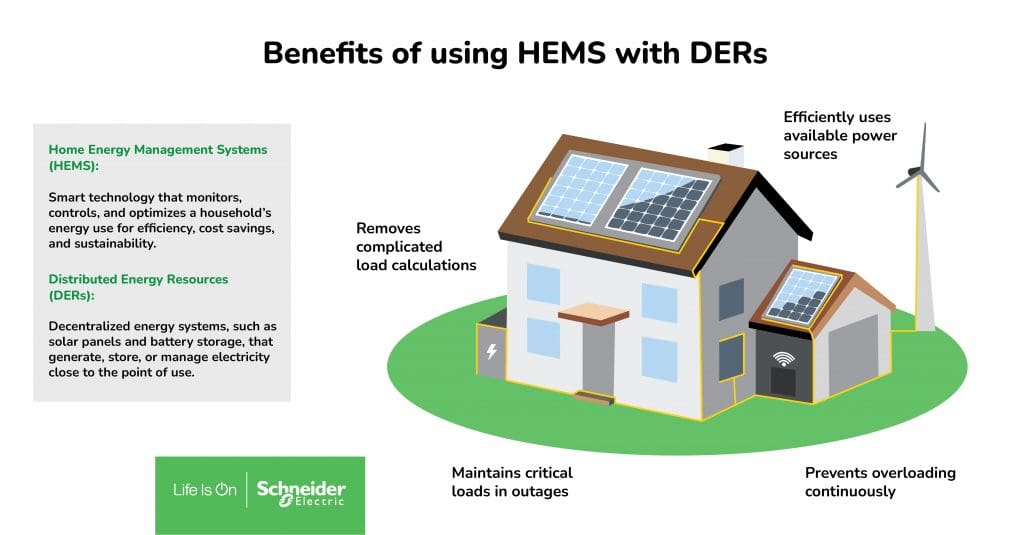
However, 705.13 provides a much easier way to efficiently handle the connection of power sources without complex calculations and engineering supervision by allowing Energy Management Systems (EMS). An EMS dynamically manages energy flow to ensure that equipment and cables are not overloaded, which is explored in the next section. In the context of residential installations, these are often referred to as Home Energy Management Systems (HEMS).
What is 705.13?
705.13 gives guidance on the installation of HEMS to manage power distribution within the home. Based on DER output and cable and equipment ratings, HEMS limits current flow in DER interconnection equipment and cables. These systems automate the processes of this type of energy management. This eliminates the need for manual calculations to prevent the overload of interconnection cables and equipment. Therefore, the home’s electrical panel can operate seamlessly, handling the DERs with ease.
An additional requirement for a HEMS is compliance with NEC 750.30, which contains detailed requirements that ensure that the HEMS can effectively manage connected loads. During an outage, essential household systems can remain operational without the risk of overloading or failure of the interconnection equipment.
Benefits of using HEMS with DERs in line with 705.13
Using a HEMS can certainly make an electrician’s job easier, as it reduces the complexity of manual load calculations, which may require an engineer on the job. HEMS manufacturers handle this at the beginning of the process, which limits the risk of costly errors and allows contractors to move on to their next job more quickly.
Using a HEMS, such as Schneider Pulse, can also prevent overloading due to load changes over time since they can continuously monitor loads. In response to changes, for example, when multiple high-power appliances operate at the same time, HEMS adjusts automatically to prevent the interconnection equipment from being overloaded.
Additionally, homeowners can benefit from the resilience a HEMS provides through shedding non-critical loads in the event of an outage. This means that the home’s most important loads can continue to run smoothly, with no inconvenience to the homeowner.
HEMs are also incredibly efficient and can decide where to draw power from when required. This maximizes performance and keeps bills to a minimum.
As more homeowners take to powering their homes with alternative energy sources, it is vital that electricians become more familiar with NEC705.12 and NEC 705.13.
It is also advisable for electricians to do more research around HEMS as they are a great way to simplify calculations and manage power from DERs.
Electricians who understand these codes will be much better equipped to guide their customers through changes as we experience a transition in energy consumption. Inevitably, those electricians who position themselves as knowledgeable resources around these codes will be set for greater business resilience in a market that is rapidly being driven by renewables.
For more information on Schneider Pulse – please visit the Residential and Small Business Products page.
The information in this blog is for educational purposes only and does not replace professional advice. Proper training and relevant certification are essential before undertaking any electrical work.
Working with electricity can be hazardous without a thorough understanding of the National Electrical Code (NEC). Always follow the latest NEC regulations applicable in your state when working with electricity.
For more information on the NEC, please visit the National Fire Protection Association (NFPA) website.




Add a comment