As sustainability becomes a central pillar of industrial innovation, understanding how to measure and communicate the environmental impact of products is more important than ever. One of the most widely used indicators is the Product Carbon Footprint (PCF) – but not all PCFs are created equal.
This article explores the different approaches to calculating carbon footprints, why scope matters, and how Schneider Electric applies rigorous, transparent methods to assess and reduce the environmental impact of its products – illustrated through a real-world case study.
What is a Product Carbon Footprint (PCF)?
A PCF quantifies the greenhouse gas emissions associated with a product, expressed in kilograms of CO₂ equivalent (kgCO₂e). It is typically calculated using Life Cycle Assessment (LCA) methodologies, which can vary in scope:
- Cradle to Gate: Includes emissions from raw material extraction (A1), transport to the manufacturing site (A2), and manufacturing processes (A3).
- Cradle to Grave (or Cradle to Cradle): Extends the analysis to include distribution, installation, use, maintenance, and end-of-life treatment (A4 to C4).
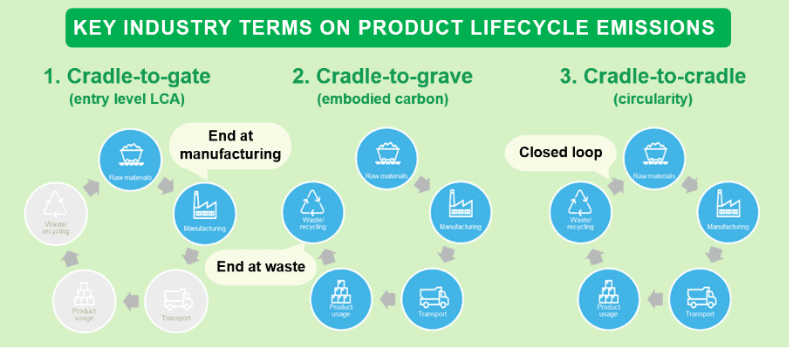
The broader the scope, the more accurate and actionable the data becomes for sustainability decision-making.
Why scope matters: A closer look at lifecycle phases
Limiting the PCF to early lifecycle stages (e.g., A1–A2 or even A1-A3) may result in a lower reported footprint, but it omits significant emissions from later stages such as product use and end-of-life. This can lead to incomplete or misleading comparisons between products or brands.
At Schneider Electric, we use Product Environmental Profiles (PEPs) – third-party verified documents that summarize full LCAs across all lifecycle phases. These PEPs are aligned with the PEP Ecopassport® program, ensuring consistency, transparency, and credibility.
Case study: PanelSeT SFN enclosures
To illustrate the importance of scope and methodology, let’s look at the PanelSeT SFN product line.
- The full lifecycle carbon footprint of a typical PanelSeT SFN enclosure is reported to be 745 kgCO₂eq, covering all phases from raw material extraction to end-of-life.
- When isolating only the A1–A3 phases (raw materials and transport), the impact is approximately 362 kgCO₂e, representing just 48% of the total footprint.
- This means that over half of the product’s emissions occur during distribution, installation, use, and end-of-life phases that are often excluded in partial PCF disclosures.
This case highlights the importance of full-scope assessments to truly understand and reduce environmental impact.
End-of-life considerations: The role of recycling
End-of-life (EoL) scenarios can also significantly influence PCF results. For example, recycling steel—a common practice used for enclosure products and selected by Schneider Electric—emits more CO₂ than landfilling or incineration but contributes better to circularity and resource efficiency.
In the case of PanelSeT SFN:
- Recycling contributes to 97% of the EoL emissions.
- Alternative scenarios like landfilling or incineration would reduce the reported emissions but at the cost of sustainability.
- Circular initiatives like the recycling of resources avoids supplementary CO2 emissions. These avoided, so negative emissions can be found in the module D. They are out of the product life cycle boundaries in Cradle-to-Gate models like PEPs but integrated in Cradle-to-Cradle models.
- In the case of the PanelSeT SFN, benefits are -338 kgCO2eq thanks to the recycling of steel. It means that in a real Cradle-to-Cradle model, the enclosure’s total lifecycle emissions are 406 kgCO2eq.
This reinforces the need for realistic and responsible assumptions in lifecycle modeling.
Our approach: Transparency, rigor, and continuous improvement
Schneider Electric’s environmental assessment process is built on:
- Over 2,000 PEPs published, covering 80% of product turnover
- Use of EIME software and sensitivity analysis for robust modeling
- Third-party verification through the PEP Ecopassport® program
- Integration of EcoDesign principles to reduce impact at every stage
This approach not only supports our own sustainability goals but also helps our customers address their Scope 3 emissions with confidence.
Conclusion: Raising the bar for environmental transparency
As the demand for sustainable products grows, so does the need for credible, comparable, and complete environmental data. By embracing full lifecycle assessments and transparent communication, we aim to empower customers, partners, and policymakers to make informed, impactful decisions.
Because sustainability isn’t just about numbers – it’s about trust, responsibility, and long-term value.
Discover and understand our product environmental footprint.
About the author
Yves Saisset, Head of Marketing Schneider Universal Enclosures
Yves Saisset is an experienced marketing manager, currently working as Head of Marketing for Universal Enclosures at Schneider Electric, based in Grenoble, France. His career spans several key roles within Schneider Electric France and International showcasing a deep expertise in industrial marketing, product strategy and sales. He has led initiatives that significantly enhanced brand positioning and market penetration across France and Europe.




Add a comment