Power systems are getting smart
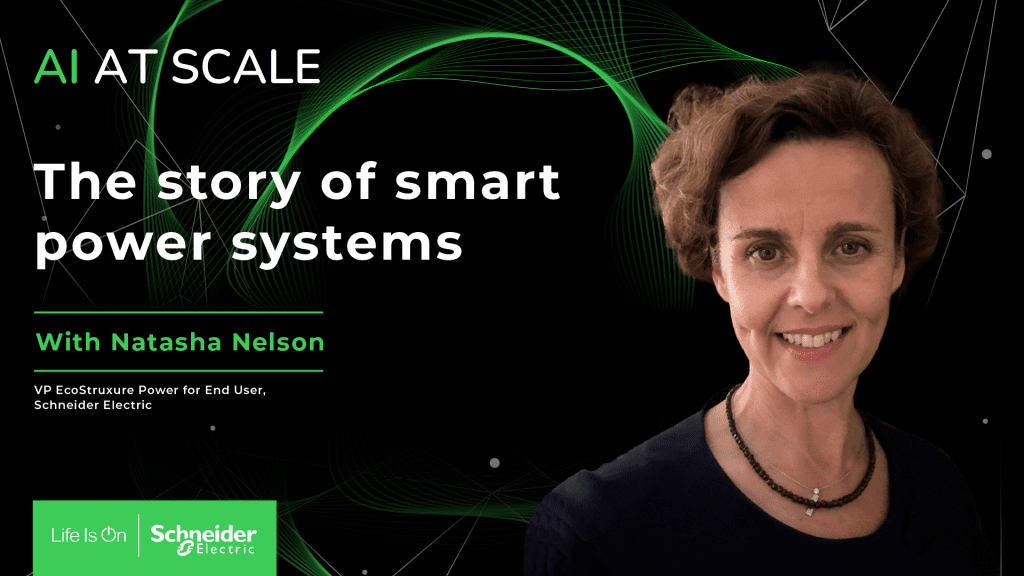
Smart watches, smart washing machines, smart homes… what about power systems? Are they also getting smart? In the next episode of the AI at Scale podcast we invite Natasha Nelson, VP, EcoStruxure Power for End User at Schneider Electric to unveil the topic of smart power systems.
Smart systems are equipped with sensors which capture temperature, humidity, chemical composition and external factors, but the real intelligence is unlocked by predictive analytics. Thanks to AI and machine learning we can detect anomalies, trends, aging process, operations, and patterns. How does it look in practice? Listen to the episode and find out!
Listen to the AI at Scale podcast
Listen to Natasha Nelson: The story of smart power systems episode. Subscribe to the show on the preferred streaming platform (Apple Podcasts, Spotify).
Transcript
Gosia Górska: Hi, I’m Gosia Górska, and I’m the host of the Schneider Electric AI at Scale podcast. I’m very pleased to introduce today Natasha Nelson. Natasha is Vice President, EcoStruxure Power for End Users and Chief Technology Officer of Services. She specializes in secure digital business, digital strategy, and energy management. She has more than 20 years of international experience in energy management, IoT, travel, and hospitality industries. Welcome, Natasha.
Natasha Nelson: Thank you. Thank you, Gosia. Nice to be with you.
The Rise of Smart Power Systems
Gosia: The topic that I wanted to start today is about everything is smart and everything is getting smart, partially thanks to artificial intelligence but also to other technologies. So we have smartwatches, smart washing machines, smart homes. When it comes to your area of expertise, do you see the coming of smart power systems? Are they also getting smart?
Natasha: Yes, very good question. They are, in fact, getting smart. We call them active. That means they are actively communicating and emitting signals. You know, power systems that are really comprised of electrical equipment and controls—typical examples would be medium voltage or low voltage switchgear, transformers, UPS, cooling systems. So everything on an electrical single-line diagram—they’re all becoming smart.
What’s interesting is these systems typically would last 40 plus years. When our customers buy them, they buy them for a very long time. And what that means is that these systems will have to be future-proofed because, in the next 40 years, we will all go through the energy transition. And the way these systems are used, they really need this intelligence; they need to be active, they need to be smart in order to prepare for this massive electrification trend that is ahead of us.
And so with this trend, we see that companies are shifting the way they operate these power systems. They will be faced with weather conditions, with scarce technical resources, with a new, much more complex energy system. And therefore, it’s kind of necessary that the systems we build today are smart, and they’re becoming smart right away from our factories, from our manufacturing.
Gosia: Yeah, that’s a big difference because if you think about the smartwatch, you usually buy it for a few years and then you need to change, mainly because of the battery. But then when it comes to power systems, you mentioned 40 years. This is really impressive. So what does it mean exactly for such systems to be smart?
What Makes Power Systems Smart
Natasha: Yeah, so of course the systems themselves are equipped with sensors and a lot of electronics. These sensors, they sense everything: they sense temperature, humidity, cables, some chemical composition, external factors. But then by itself, that’s not enough. So the data is then transmitted, and there’s a lot of analytics, predictive analytics—a lot of them are powered by AI and machine learning.
And then from these analytics, we start to detect anomalies, trends, aging, operations patterns. We can correlate multiple variables, and that allows us to know, is there a risk? Is it changing any kind of maintenance? We can get much, much smarter about how and when we need to do maintenance, and that’s what we focus on. But then the question is what to do about it. So once you have the analytics, we need to pair it with the expertise—somebody who can say, ‘Hey, I see this pattern or this trend, so what?’ And so here we pair these—all the outcomes of all these analytics—with our, we call it, domain expertise. And here we have experts, and here again, we’re leveraging AI to kind of supercharge that expertise as well.
Gosia: Okay, so in a sense, the first layer is all the sensors that are directly at the power systems, and they are, as you mentioned, connecting with other systems. They are basically capturing all this information. But then the intelligence comes when you have a domain expert and when you have AI to basically do more advanced analytics. Could you give an example of a company that is already benefiting from the smart power systems, and what do they appreciate the most? How does it look like in practice?
Real-World Application: Nestlé’s Success Story
Natasha: Yeah, that’s a good question. So let me give you an example of Nestlé. Nestlé, and Nescafé specifically, one of their largest soluble coffee factories is located in Mexico, producing 1 million jars of soluble coffee, operating 365 days a year, and simply cannot afford any downtime. However, they have experienced this downtime in the past several times, causing productions to falter, and that was costing them $52,000 per hour. These losses and detrimental factors made them rethink their maintenance strategy.
There was a single disruption in April of 2020. There was actually a short circuit inside an unmonitored section of the main substation, and it resulted in a 14-hour shutdown. So you can imagine the math behind it. It was costing them upwards of $580,000 in losses—just this one incident. And the section was really not connected; there was no IoT, no analytics, and the engineers weren’t alerted that the equipment was at risk.
So they decided to move from reactive maintenance—meaning that somebody comes once a year and checks—to a predictive maintenance approach. First, they modernized their production equipment. We outfitted it with all the sensors that we recommended. They subscribed to a service plan that monitors this equipment in real time, and they were able to avoid three stoppages per year. They get real-time remote visibility on all of their electrical assets’ health. They ensure business continuity, and of course, they increase operational efficiency of how they operate the factory and how they do maintenance in the first place. So pretty happy outcome, pretty happy customer there.
Gosia: Yeah. It makes me think of a funny metaphor because we usually say that AI is a bit like a black box, that you don’t know what’s happening inside. But actually, in this case, the black box was actually at the premise. This was the area that was not connected, that nobody had the visibility on, and this was causing actually some risks for the company. So this is really interesting, and let’s talk about the people in this case. How does it change the life of employees operating on these systems?
Impact on Employees and Maintenance Practices
Natasha: Yeah, sure. It’s a very good question, thank you. Because maintenance activity is typically people’s jobs, and somehow that doesn’t really change now that, like you said, there was a black box—the electrical equipment was a black box—but actually, AI sort of opened their eyes to see what is actually going on inside, and it actually made it more transparent.
So now we still need to do maintenance, but maybe sometimes we don’t need it when we don’t need it. Maybe we need it sooner than we had thought, and we can actually move to a smart maintenance, if you can call it like that, right? Because you do maintenance when it’s needed, you are not only able to plan it better, know it better, and do it when it’s really needed, but you become more efficient in the use of your resources, and you extend the life cycle of your equipment that is meant to last a long time.
Another good example for the people side is avoiding unnecessary shutdowns. Some shutdowns can be planned or unplanned. So even if it’s planned, it’s still kind of an arduous task, right? You need to find the time, you need to coordinate everything, you need to prepare. These shutdowns for such factories are difficult, but they can be avoided. Why have it in the first place if it’s not necessary, right? And that really helps people to allocate their time to something more productive and better use of their time instead of planning a shutdown that is not necessary.
The third most common impact on people is the avoidance of risk of electrical failure, right? These events, like the one I just described from Nestlé, they could be quite stressful because there’s loss. First, they’re unexpected, then there is a loss of production time. It could be quite devastating. So eliminating that, also helping people to feel, first of all, safer, feel sort of a peace of mind, and really knowing that it’s covered. They can be focused on something much more productive as far as how they will use their time. And for service technicians, they really need to then focus only on what is the highest area of risk and become more preventative, anticipating things in the future, and have a peace of mind that the monitoring service is taking care of the risk.
AI and Sustainability: Extending Asset Lifespan
Gosia: Yes, you mentioned one thing that caught my attention because it was also mentioned in the conversation between ARC analyst Colin Masson that he recently had with our Chief AI Officer, Philippe Rambach. They were talking about the link between using AI solutions and sustainability. And one area that is, for me, absolutely not obvious is how we can use AI in the context of services to extend the lifespan of assets. Could you explain a bit more the concept?
Natasha: Yes. Well, like I said previously, the equipment and its components are meant to last 40 years, right? I mean, depending on if some is shorter, the other one is longer, but it’s meant to last. And besides being ready and future-proofing for the energy transition, we also carefully track the aging over the key components of this equipment. So we have this aging framework that knows how and when each component of the system will age, and is it aging faster than expected or not.
So we calculate this composite maintenance index and propose a maintenance window, and we know with a pretty high level of precision what and when, how it needs to be replaced or retrofitted, and when certain parts need to be ready. What does that mean? It’s just like with our cars. If I can give you another example: if you take good care of your car, you will keep your car for a much longer time. If you maintain it, if you take care of it, you prolong the life of your car. It’s the same with a power system.
And, you know, these power systems, they take a lot of energy and a lot of raw material to manufacture, to deliver, to assemble, to build. So if you are avoiding having to replace big parts of it, or all of it, when it’s not necessary, and if you make it live a few years longer, you have just made a pretty good impact on the environment. You’re basically avoiding unnecessary depletion of natural resources and unnecessary use of manufacturing facilities, transportation, and so on.
Just let me give you some facts on this one. The use of our maintenance index can extend the maintenance lifecycle up to five years, right? Compared to corrective reactive break-fix methods, preventative and predictive maintenance savings can reach 12 to 18%. And finally, our research reveals that more than 67% of breakdowns can be avoided through formalized maintenance services. So you see, the impact is not small.
Gosia: Yeah, that’s huge. Actually, five years—that is really a long time. Here we talk about predictive analytics. And of course, we cannot have an episode without mentioning what’s happening on the GenAI side. I’ve seen your recent blog written with two colleagues, also from Schneider Electric, in which you mentioned three ways that GenAI is helping our services experts. Can you share a bit more about this?
Empowering Service Technicians with Generative AI
Natasha: Yeah, exactly. So when we think about our systems and our equipment, we think that they’re becoming active or smart, right? Because we have all the sensors and now they need data, so they’re active. But when it comes to GenAI, we think more about our people, because GenAI is helping people, and our service technicians in particular. And we think of it as we’re giving them superpowers—our people acquiring superpowers. So we have this parallel, which I think is really great.
GenAI is helping in three ways, and I come back to the service topic. First, there are tasks associated with drafting predictive maintenance recommendations. So we got the data, we got all this smart analytics. But actually, what is step one, step two, step three? When should I do so? These recommendations are a written report, and this is the first superpower that GenAI is helping to create. In the past, you see, these recommendations were based on standard maintenance procedures. And today, GenAI helps to draft a very custom, very tailored for you—given the history of your installation—what exactly should be the maintenance process. It creates the first draft in seconds, and then the engineer can finalize with their real knowledge and prepare maintenance recommendations. This is number one superpower.
Number two is a virtual expert. This expert is a virtual assistant built for our service technicians. So it’s sort of an expert of an expert, if you can call it like that. Our technicians are able to ask the chatbot a very technical question because they are in front of equipment from all kinds of different—sometimes it’s 10, 15, 20 years old—and there could be different indicators. There’s a vast library that we carefully curated for them. Basically, they’re asking the library a question in real time. That’s what ‘Ask an Expert’ is about.
The third superpower that GenAI is helping is really summarizing the insights more efficiently. These teams sometimes need to just give a summary to the customer, and it may sound pretty trivial, but it is very helpful because they write a quarterly report. This quarterly report is formally delivered, or an annual report, and it’s formally delivered as part of the service contract. Now sometimes they take hours to summarize a vast amount of information, and really it’s not a super good use of their time. So it’s kind of a very nice superpower to just summarize something so complex and long. And, you know, GenAI speaks very good English or very good language—it could be Spanish, could be French. So we summarize and then we translate, and I think that’s really, really nice and very important. Superpower number three.
Gosia: Yeah, so it sounds like it’s a great assistant. So on one side we have smart systems, on the other we have superhero services experts.
Preparing for the Energy Transition
Gosia: My last question would be what kind of advice you can give to our audience from the business sector where they should start if they want to prepare for the energy transition, to be less vulnerable about the extreme weather conditions and other disruptions. So in short, how to get to the point of having smart power systems.
Natasha: Yes. Well, look, what we recommend to most of our customers, of course, is to what we call understand their install base. Maybe you can start with a very simple assessment of what they have, which assets are critical, which assets are not critical. We’re very happy to have that small consulting engagement to help with that. And then we can certainly recommend where to start, what to digitize first, what to connect, what should be monitored. And we also are very happy to advise our customers on their electrification journey to help them prepare for electrification as well. These are the kind of consulting efforts that we do a lot for our customers. And once they get started, we then kind of craft a plan together and go step by step.
Gosia: Yeah, that’s really great advice. Thank you, Natasha, for joining us today. I really appreciate the time and the fact that you shed some light on how we are using AI at scale in power systems. Thank you so much.
Natasha: My pleasure. Thank you for having me.
Like what you hear?
- Visit our AI at Scale website to discover how do we transform energy management and industrial automation with artificial intelligence technologies to create more sustainable solutions.
- Listen to the other episodes of the AI at Scale podcast.
AI at Scale Schneider Electric podcast series continues!
The first Schneider Electric podcast dedicated only to artificial intelligence is available on all streaming platforms. The AI at Scale podcast invites AI practitioners and AI experts to share their experiences, insights, and AI success stories. Through casual conversations, the show provides answers to questions such as: How do I implement AI successfully and sustainably? How do I make a real impact with AI? The AI at Scale podcast features real AI solutions and innovations and offers a sneak peek into the future.



Add a comment