Across recent sustainability discussions with medium-voltage customers, no topic surfaces more consistently than circularity. While decarbonization remains a key priority, customers increasingly want to understand how they can extend asset life, avoid unnecessary replacement, and recover more value from the equipment they already own.

Across utilities, infrastructure, industrial facilities, and commercial buildings, organizations are examining the lifecycle of their electrical assets. They want to avoid unnecessary waste and premature replacement while improving repairability and preparing for responsible end-of-life management.
The conversation is no longer only about buying new equipment. It is about maximizing the value of existing assets throughout their lifecycle.
From replacement to value retention
Medium-voltage asset owners and operators frequently face a difficult choice. A component reaches the end of its service life, spare parts become difficult to source, or a product is no longer supported. Sometimes, an entire switchgear lineup must be replaced even though much of the equipment remains functional.
That can create unnecessary costs, operational disruption, and material waste.
Customers are therefore looking for solutions that help them maintain, repair, modernize, and upgrade existing assets where practical. They want access to spare parts, including refurbished options where appropriate, to help extend asset life while avoiding unnecessary replacement.
They also want confidence that equipment can adapt to changing requirements over time.
In short, they want assets that are built to last and supported throughout their lifecycle.
Why circularity matters in medium voltage
The traditional linear model of “take, make, use, dispose” is becoming harder to justify, both economically and environmentally.
Circularity offers a different approach by keeping products, components, and materials in use for longer. The Ellen MacArthur Foundation’s circular economy principles emphasize retaining their highest possible value through maintenance, reuse, repair, refurbishment, remanufacturing, and, ultimately, recycling.
For medium-voltage systems, this can mean:
- Designing equipment for easier maintenance and repair
- Extending asset life through preventive and condition-based maintenance, modernization, and retrofits
- Providing spare parts throughout the equipment lifecycle
- Reusing or refurbishing suitable components
- Recovering materials when equipment reaches end of life
- Offering take-back services that support responsible disposal
These measures can reduce environmental impact while improving resilience, lowering total cost of ownership, and reducing operational risk.
Circularity also influences how customers evaluate new technologies. As utilities and industrial operators transition to SF₆-free switchgear, they are considering not only environmental performance, but also equipment longevity, maintenance, and end-of-life handling.
As I discussed in SF₆-free medium-voltage switchgear: A path to the SF₆ transition, effective sustainability solutions must help customers prepare for the future while maintaining operational reliability today.
End-of-life responsibility
Another recurring question is what happens when equipment reaches the end of its useful life.
Operators may need to arrange decommissioning, transportation, recycling, and disposal. When equipment contains regulated materials or requires specialized handling, the process becomes even more complex.
Customers are increasingly looking for manufacturers and partners that can support this stage through take-back services, material recovery, and responsible end-of-life management.
As explained in How to turn MV equipment end of life into a sustainability opportunity through SF₆ recovery, SF₆-filled equipment requires properly managed recovery and treatment. The article also explains how take-back services can support controlled dismantling, material recovery, documentation, and the transition to SF₆-free technologies.
End-of-life management is therefore not simply about disposal. It is an opportunity to recover value, reduce environmental impact, support broader sustainability objectives, and comply with regulations.
Turning circularity into action
At Schneider Electric, we believe circularity begins with circular design and extends across the product lifecycle. Designing for durability, repairability, modernization, and eventual recovery helps preserve value long before equipment reaches end of life.

Our approach is based on three principles: Use Better. Use Longer. Use Again. This includes designing for durability and repairability, modernizing existing assets, managing spare parts, recirculating products and components, and recovering equipment at end of use.
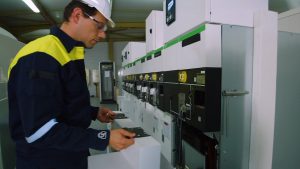
In medium voltage, EcoFit™ modernization and circularity services help extend equipment life through repairability, spare-parts management, switchgear modernization, and take-back services
The objective is straightforward: help customers preserve asset value while minimizing unnecessary replacement, waste, and resource consumption.
A smarter path forward
Circularity is often viewed through a sustainability lens, but it is equally a business strategy. The World Economic Forum describes circularity as an economic and industrial strategy that can strengthen resilience, resource security, and competitiveness. It can also help improve resilience to critical material constraints by retaining valuable resources such as copper and other essential materials in use for longer, reducing dependence on increasingly constrained supply chains.
For medium-voltage operators, the opportunity is clear. By prioritizing repairability, modernization, refurbishment, and responsible end-of-life management, organizations can derive more value from existing assets while building more resilient electrical infrastructure.
Circularity is not about extending equipment life at all costs. It is about making smarter decisions throughout the lifecycle, preserving value where possible and managing end of life responsibly when replacement becomes necessary.
How is circularity shaping your asset management strategy? Where do you see the greatest opportunities to extend equipment life and recover value?
Learn more
Explore Schneider Electric’s Use Better. Use Longer. Use Again. circularity approach and watch How Schneider’s Circular Business Model Is Powering a Sustainable Future. Let’s continue the discussion – connect with me to learn more.


Add a comment