
As regulatory requirements continue to evolve, gas distribution operators face growing pressure to demonstrate network safety and reliability. They must also show strong environmental performance across their operations. Requirements include Distribution Integrity Management Program (DIMP) compliance and pipeline replacement initiatives. Utilities are also working to meet methane emissions reduction targets and PHMSA regulations. Additional expectations include state-level reporting requirements and expanding ESG commitments. As a result, utilities are being asked to do more with greater transparency and accountability than ever before.
At the same time, aging infrastructure, extreme weather events, population growth, urban development, and shifting energy policies are creating new operational risks across the distribution network. Utilities are collecting more asset, inspection, leak survey, and operational data than ever before, but data alone does not improve decision-making.
To effectively manage risk, prioritize investments, and maintain compliance, gas operators need a clear understanding of how their network behaves. They must be able to visualize pressure systems, understand the downstream impact of outages or maintenance activities, identify infrastructure vulnerabilities, and assess how asset risk is evolving across the system.
In today’s regulatory and operational environment, knowing where assets are located is only the starting point. Understanding how the network performs and where risk exists is what enables safer, more resilient, and more efficient operations.
This is where EcoStruxure ArcFM delivers value for gas utilities and their customers.
Built on Esri’s ArcGIS Utility Network and optimized within Schneider Electric’s One Digital Grid Platform, EcoStruxure ArcFM helps utilities transform geospatial information into actionable operational insight.
By connecting GIS, IT, engineering, integrity management, and operational systems across the enterprise, utilities gain greater visibility and governance. This connected approach improves coordination across teams and supports safer management of modern gas distribution networks.It also helps utilities advance long-term modernization initiatives with greater confidence and efficiency.
Managing safety, risk, and compliance in a changing environment
Safety remains the defining priority for every gas utility.
Operators must continuously manage risks associated with pressure containment, leak prevention, public safety, environmental stewardship, and regulatory compliance. At the same time, utilities are replacing aging infrastructure, documenting asset histories, supporting emissions reduction initiatives, and maintaining increasingly detailed records required by regulators.
Many organizations still struggle with fragmented workflows, disconnected records, paper-based processes, and inconsistent information across engineering, operations, construction, integrity management, and compliance departments. When teams operate from different versions of the network, decision-making slows, risk increases, and confidence in operational data declines.
Addressing these challenges requires more than a system of record. Utilities need a connected operational view of the network that supports safety, compliance, planning, and infrastructure investment decisions across the entire asset lifecycle.
A living digital twin for the modern gas utility
EcoStruxure ArcFM addresses these challenges by transforming GIS from a static repository into an operationally focused platform.
At the core of the solution is a living digital twin. It provides a continuously maintained representation of the gas network. The digital twin supports planning, design, construction, and operations. It also supports integrity management and compliance functions. Rather than maintaining isolated datasets across departments, utilities establish a common network model that supports enterprise-wide decision-making.
Changes captured during engineering and construction workflows are governed and validated before becoming operational reality. Operational systems, planning applications, integrity programs, and enterprise business systems can all leverage the same network information, creating greater consistency across the utility.
The result is stronger governance, improved situational awareness, greater visibility into network risk, and faster operational decision-making.
Managing risk across the gas distribution network
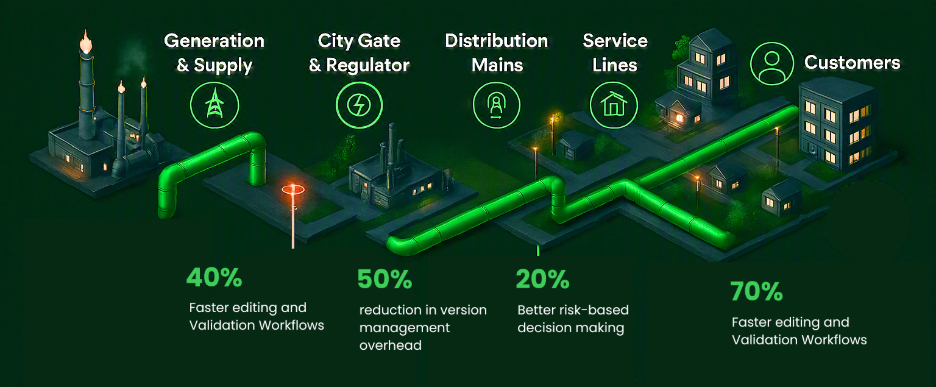
Unlike other utility networks, gas operators must continuously manage pressure systems and integrity risks. They must also address regulatory obligations, public safety requirements, and evolving environmental expectations. Within the EcoStruxure ArcFM ecosystem, utilities can maintain a connected model of their gas network. This model reflects how the system actually operates across the field. It includes pressure districts, regulator stations, valves, and transmission interconnects. The model also incorporates service lines, customer associations, and cathodic protection infrastructure.
This operational context provides engineers, control room personnel, and field teams with a deeper understanding of how gas moves through the network, where pressure boundaries exist, and how operational changes may impact customers and system performance.
These capabilities support critical workflows that directly affect safety, reliability, and compliance. Operators can identify customers affected by planned or emergency valve closures, evaluate regulator station impacts, establish isolation plans for maintenance activities, and understand network consequences before operational changes occur. During emergency response events, crews gain faster visibility into affected facilities, pressure zones, and critical customers, helping reduce response times while improving operational coordination.
For integrity management programs, this network intelligence becomes a foundation for risk-informed decision-making. Utilities can connect asset condition, pipe material, vintage, operating pressures, leak history, inspection records, and replacement priorities within a unified environment. This supports DIMP requirements, pipeline safety initiatives, and long-term modernization programs focused on reducing infrastructure risk.
As regulatory expectations continue to evolve, utilities face growing demands related to pipeline safety management systems (PSMS), methane emissions reduction programs, leak detection and repair initiatives, asset traceability, and operational transparency. Meeting these obligations requires more than accurate mapping. Utilities need network information capable of supporting engineering analysis, integrity assessments, compliance reporting, and operational planning across the entire gas system.
By preserving network connectivity, pressure relationships, customer impacts, and asset attributes, EcoStruxure ArcFM supports a governed enterprise environment. It helps gas utilities strengthen integrity management programs and improve compliance outcomes. The solution also supports more informed infrastructure investment decisions.
Real-world use case: Connecting design, construction, and operations
One of the most significant challenges facing gas utilities is ensuring that network changes move efficiently from design and construction into operations.
Historically, paper sketches, redlines, construction records, and manual GIS updates often created delays between field completion and operational readiness. These processes introduced opportunities for data quality issues, duplicate effort, and inconsistent network records.
EcoStruxure ArcFM digitizes and orchestrates this lifecycle. Designers create network modifications within GIS-based workflows while integrating with work management, asset management, and enterprise systems. Validation occurs earlier in the process, helping ensure network accuracy before assets are placed into service. Field crews can capture as-built conditions at the source, reducing manual data entry and improving data quality across the organization.
The outcome is faster project execution, safer operations, improved regulatory compliance, and greater confidence in operational data.
Real-world use case: Supporting risk and integrity management
Modern gas utilities increasingly depend on risk-informed decision-making.
Infrastructure replacement programs, methane reduction initiatives, integrity management requirements, and regulatory reporting all require access to accurate and reliable network information.
EcoStruxure ArcFM provides governance, validation, and workflow capabilities that support these programs. Utilities can establish standardized processes for data quality management, network validation, asset governance, and enterprise coordination. Automated workflows reduce manual effort and increase confidence in information used for safety decisions. They also improve confidence in information used for critical investment decisions.
This allows integrity and compliance teams to focus less on reconciling records and more on reducing risk, improving safety, and planning future infrastructure investments.
Real-world use case: Enterprise-wide network stewardship
Network knowledge exists throughout the organization.
Field inspectors identify asset conditions. Leak survey crews collect critical observations. Compliance personnel maintain regulatory records. Operations teams manage maintenance activities. Customer service representatives often encounter issues that require investigation and follow-up.
EcoStruxure ArcFM enables broader participation through web and mobile experiences that support utility-wide collaboration. Employees across the organization can access network information, contribute updates, submit observations, and participate in governed workflows without requiring advanced GIS expertise.
Most importantly, everyone works from a common understanding of current network conditions, helping improve coordination, data quality, and operational effectiveness.
Turning data into safer outcomes
Gas utilities are not simply modernizing technology. They are modernizing how safety, compliance, integrity, and operational performance are managed across the enterprise.
As regulatory expectations increase, infrastructure challenges are becoming more complex. Utilities are judged not only by asset condition but also by their understanding of network behavior. They must proactively manage risk and demonstrate compliance through reliable operational data.
EcoStruxure ArcFM helps utilities meet these expectations by connecting people, processes, and systems across the full gas network lifecycle. Through a combination of network design, operational governance, mobility, enterprise workflows, and Utility Network-based intelligence, the solution establishes the operational foundation required for safer and more informed decision-making.
As gas utilities continue their digital transformation journeys, success will depend on turning network information into operational insight. EcoStruxure ArcFM enables that transformation, helping utilities deliver safer, more reliable, and more resilient service for the communities they serve.



Add a comment