In the not-too-distant past, data center infrastructure decisions largely centered on individual components such as racks, servers, power management, and cooling. But AI and high-performance compute (HPC) have changed that model. As compute becomes more powerful and infrastructure more complex, it takes an ecosystem of players, from advanced compute vendors to hardware manufacturers to systems integrators, to support data center infrastructure decisions.
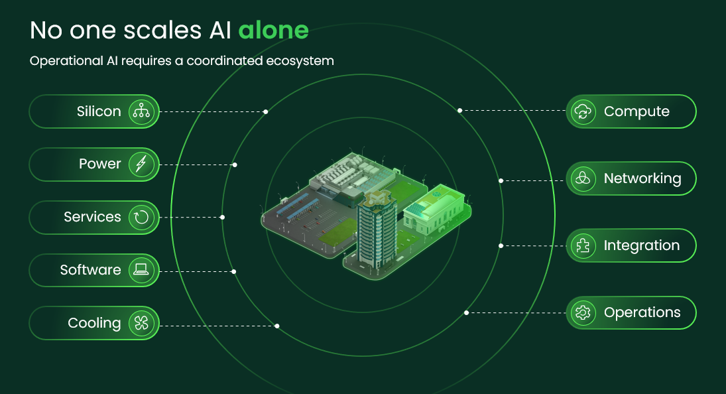
This shift is especially clear in AI power and cooling needs. Five years ago, a data center rack consumed 5 to 10 kW of power. Today, racks used in advanced computing have surpassed 100 kW, and Uptime Institute notes NVIDIA’s Blackwell NVL72 platform is rated at 132 kW per rack. This substantial power boost introduces new levels of complexity across the infrastructure. For every watt of power consumed, one watt of heat is generated that must be dissipated to avoid damaging equipment. Data center cooling, often treated as an afterthought, has become intrinsic to building design because high-density systems generate heat that requires liquid cooling solutions with pipes, manifolds, and cooling distribution units (CDUs).
As complexity increases, enterprises and data center operators increasingly rely on an ecosystem of partners to design, simulate, build, operate, and maintain AI environments. The ecosystem pulls together silicon providers, server manufacturers, infrastructure partners, systems integrators, software providers, and service organizations to help customers achieve speed, performance, efficiency, and time to value.
Connecting the infrastructure behind AI
As an infrastructure provider, Schneider Electric connects mechanical, electrical, software, management, and sustainability capabilities across the AI infrastructure lifecycle. We help customers and partners design, simulate, build, operate, maintain, and optimize AI environments through reference designs, modeling, digital twins, management software, and sustainability expertise.
But bringing AI infrastructure online requires more than individual technologies. It requires coordination across an ecosystem of advanced compute vendors, technology providers, system integrators, data center operators, and other partners. By working together earlier in the design and validation phase, ecosystem partners can identify integration challenges before deployment, reduce implementation risks, and improve deployment readiness.
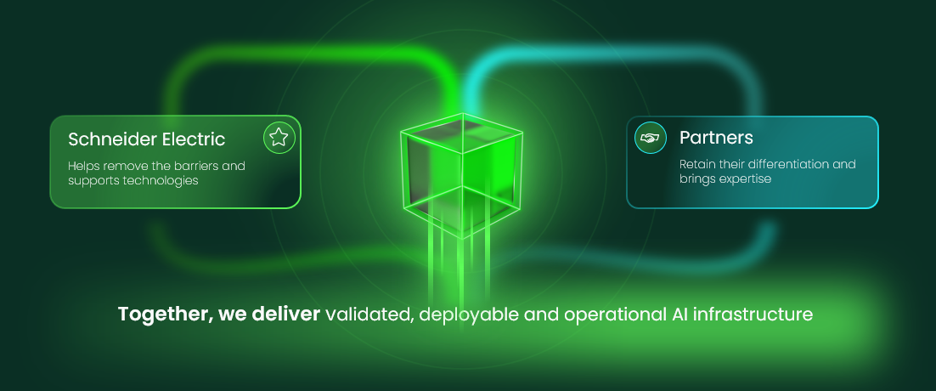
We collaborate with other ecosystem partners to develop validated reference architectures, power and cooling designs, and ecosystem testing that help customers reduce planning risk and accelerate deployment. We currently provide digital twins, simulation initiatives, and reference designs for NVIDIA’s GB200 and GB300 NVL72 chips and AMD Helios chips, with pre-engineered power and liquid-cooling frameworks.
Schneider also has a strong heritage in working with system integrators, many of which are moving into the AI and HPC space to fill customer requirements. And we have a long track record of working with hyperscalers, colocation operators, and enterprise-class data centers.
Turning AI infrastructure into business value
Schneider’s role in connecting compute roadmaps with deployable power, cooling, physical infrastructure, software, and lifecycle expertise helps deliver business value to customers. Working together with manufacturers, data center operators, and integrators, we make it easier for customers to leverage technology innovations. We help set the foundation that accelerates time to first token TTFT so everyone along the value chain can derive financial benefit from technology implementations.
We continuously work to improve the efficiency and sustainability of our products while advancing circularity through green material choices and lifecycle innovation. As AI infrastructure scales, we help customers optimize power, cooling, energy management, resilience, and carbon performance throughout the entire infrastructure lifecycle. Schneider Electric’s Advisory Services team, with more than 4,000 consultants worldwide, helps organizations develop renewable energy, decarbonization, and resource-efficiency strategies to simultaneously support long-term business growth and sustainability objectives.
Trusted collaboration across the AI ecosystem
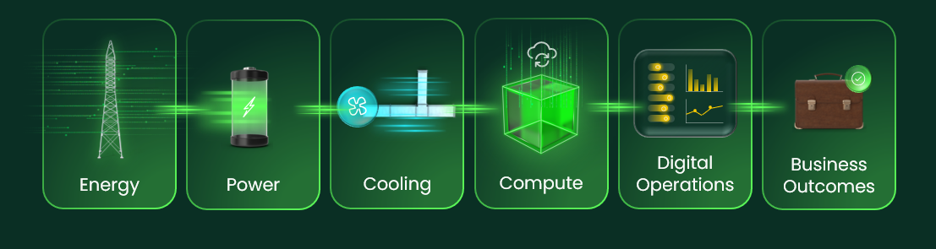
No single company can address AI infrastructure alone. Bringing increasingly powerful compute online requires coordination across compute platforms, servers, racks, power, cooling, software, and the data center itself.
Schneider Electric works across these layers, collaborating with advanced compute vendors, systems integrators, hyperscalers, colocation providers, and enterprise data centers to turn AI technology roadmaps into deployable, reliable infrastructure. Through reference designers, modeling, testing, and close ecosystem coordination, partners can address power, cooling, and physical infrastructure requirements earlier in the design process.
This reduces design rework, improves deployment readiness, and accelerates the path from planning to operational AI capacity. As AI infrastructure continues to evolve, this collaboration will become even more important.



Add a comment